

Recipe: Tinto de Verano 🇪🇸
The 'Campo Spritz' is a reliable base for exploring Spain's refreshing 'summer red,' Tinto de Verano.

Adding soda to wine—and liking it—wasn’t within my set of predictions for summer 2026, but nor was becoming absorbed by the World Cup. But team spirit, viral chants (“Ro!”), endearing protagonists, and quality time with family rendered both enriching realities.
Federico Vargas owned Venta de Vargas, a 1920s-era Córdoba inn and restaurant, and is credited with creating Spain’s beat-the-heat summer spritz, the Tinto de Verano. (The drink was initially called a Vargas, and often still is.) It’s a cinch to assemble, with just three ingredients; that allows for many variations, from glassware to garnish, so I’ve shared a few you might pursue below.
To assemble a classic Tinto de Verano, pour four ounces of fruit-forward, young Spanish red wine—more on this also follows below—over ice. Add the same amount of a quality lemon-lime soda, then garnish with sliced oranges or lemons. Vargas’ original version included simply “gaseosa,” (soda), which cooled and lightened red wine during warm summers in southern Spain. “Tinta” is Spanish for “ink” or “dye,” and commonly refers to red wine, while “verano” translates to “summer.” Valerie Li Stack writes in Punch, “Around the same time in nearby La Rambla {another Córdoba municipality}, Rafael Alguacil Romero started manufacturing soda and sarsaparilla under the name Alguacil Beverage Company. His Alguacil lemon soda, together with lots of ice, was soon added to the popular Vargas drink to impart a touch of sweetness, making it easier to throw back on a hot afternoon.” It’s commonplace to use La Casera soda, 7UP, Sprite, and so on.
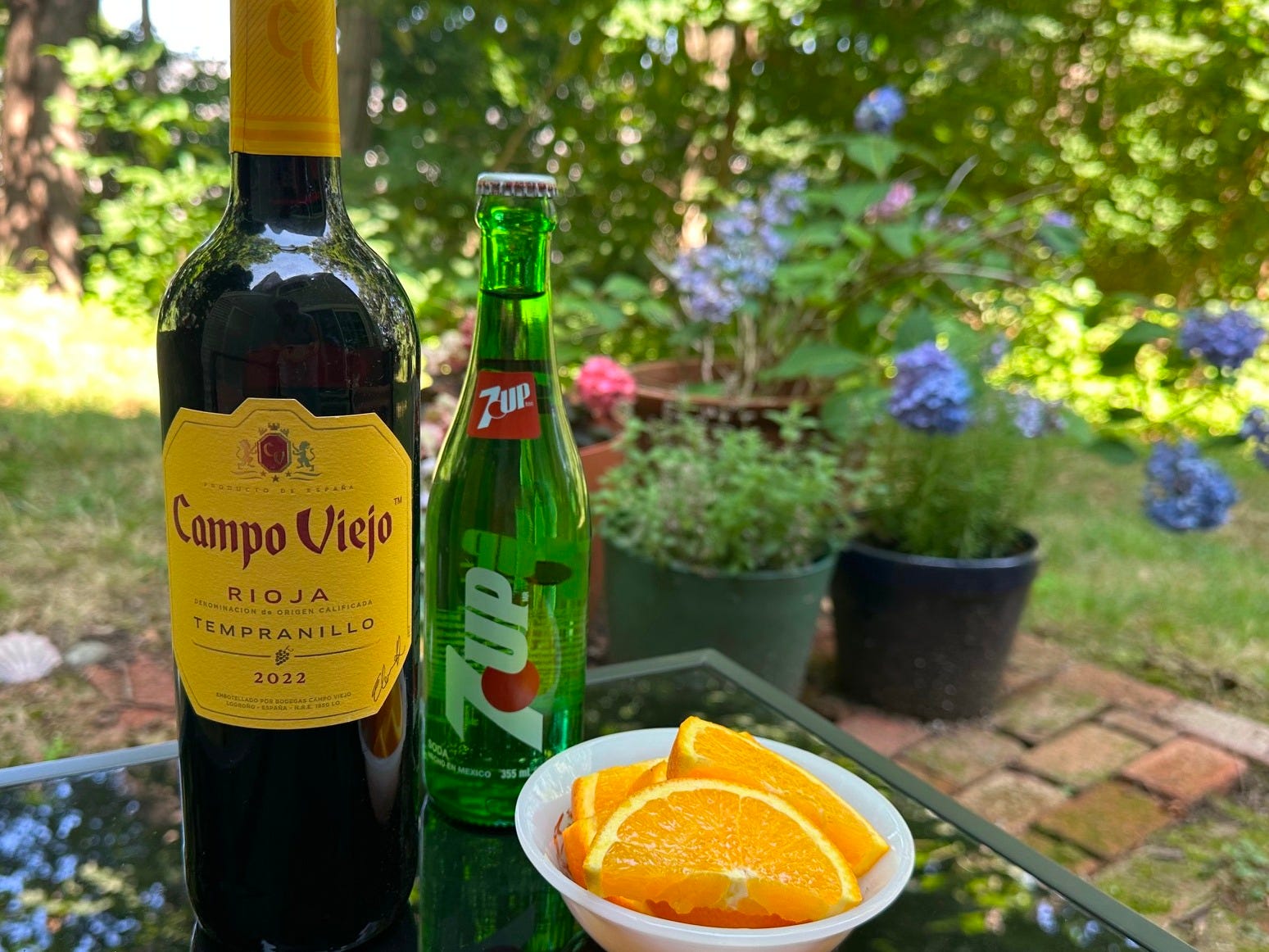
I referred to Campo Viejo’s ‘Campo Spritz’ recipe for my Tinto de Verano, with a base of Campo Viejo’s 2022 Tempranillo. The wine is aged for just four months in American oak after fermentation in stainless steel tanks. Grapes are sourced from Rioja DOCa’s three growing regions.
Before we proceed, a little context about Rioja: There are only two DOCa regions in Spain, Rioja and Priorat. To become a DOCa (Denominación de Origen Calificada), a region must be a certified Denominación de Origen (DO) for ten years; a DO establishes quality standards for grape and wine production. Priorat is southwest of Barcelona in Catalonia, and known for llicorella soils (slate, granite, and limestone), steeply terraced vineyards, and richly concentrated wines. Rioja is in north-central Spain, and its three subregions are in the Upper Ebro River valley, near the city of Logroño. Rioja Alavesa is on the river’s north bank, and vineyards vary in elevation in the Cantabrian Mountain foothills. South of the Ebro is the Rioja Alta region, where vineyard sites at higher elevation benefit from cooling Atlantic breezes, and Rioja Oriental, where hotter, drier summers are common. Tempranillo is the most planted grape variety in Rioja, followed by Garnacha (Grenache), Graciano, and Mazuelo (aka, Carignan). We can get into Rioja’s aging system and classifications in another post!
Bodegas Campo Viejo is six kilometers west of Logroño and known for sustainable practices; the winery achieved carbon neutral status in 2012. Sourcing grapes widely from a premier growing region allows high volume production wines to maintain an uncompromising standard of quality.

The classic Tinto de Verano, or Campo Spritz, coheres as you leisurely sip it. As the ice melts, citrus and zest notes are fresh and prominent. The wine offers notes of refrigerator-cool cherries and blackberries, more layers of freshness. Summer flavors meld. Given the lower ABV per serving, the Tinto de Verano is as readily enjoyed al fresco on an Andalusian plaza as in one’s backyard.
Variations 🍷
You can find a few other enticing spritz recipes here, including the Blood Orange Hugo Spritz (elderflower liqueur, blood orange juice, Cava) and the dirty spritz (sherry, olive brine, Cava, club soda) both served over ice.
A few riffs on the Tinto de Verano include adding red vermouth, using a Spanish white wine (Verdejo or Albariño, for example) as the base and perhaps adding white vermouth, curating abundant mixed citrus, substituting lemonade, seltzer, or tonic water for the soda, and experimenting with glassware. A highball glass will affect a fizzy craft cocktail, while a wide-bowled wine glass invites slower sipping, allowing time for the wine’s aromas to register and clarify.
“Read on…” will be back next week!
Tasty and timely!
From one Cup to another...